Posts by author:

John Q

Utilitarianism: it all went wrong with Sidgwick

by John Q on January 14, 2026

As part of my critique of pro-natalism, I’m looking at the philosophical foundations of the idea. Most of the explicit discussion takes place within the framework of consequentialism (the idea that the best actions or policies are those with the best consequences) and particularly of utilitarianism, broadly defined to say that the best consequences are those which maximise some aggregate function of individual happiness or wellbeing. Other philosophical traditions either avoid the issue (for example Rawls’ theory of justice) or offer little that can illuminate debate over population numbers (for example, virtue ethics).

Looking at the utilitarian analysis immediately creates a puzzle. All the early utilitarians, from Jeremy Bentham to John Stuart Mill supported population limitation. They accepted Malthus’ claim that, in the absence of limitation, population growth would inevitably reduce the great majority of people to subsistence. But unlike Malthus, who used this argument to say that attempts to make the poor better off were futile (he rejected birth control as “vice”) the early utilitarians accepted the desirability of limiting family size.

Most notable among this group was Francis Place. Taking significant legal risks in the repressive climate of the time, Place sought to spread information about contraceptive methods in pamphlets such as Illustrations and Proofs of the Principle of Population (1822).

Importantly, and in contrast to many 20th century Malthusians, Place rejected coercive measures, placing his trust in families to make prudent decisions given access to information and the methods of family planning. Except for his failure (unsurprising at the time) to consider possible conflict within households, Place’s position stands up very well 200 years later.

The classical utilitarians argued for public policies which promoted the welfare of the community to which they applied, on the basis of “each to count for one, and none for more than one”. This applied both to the current population and to the children who would actually be born as a result of their choices, but not to hypothetical additional people who might raise the sum of total utility.

By contrast, contemporary utilitarian philosophy yields bizarre spectacles like “longtermism” which implies that our primary goal should be to produce as many descendants as possible provided that the result is an increase in aggregate utility. This is taking Parfit’s “Repugnant Conclusion”, which I criticised here, to its logical limit.
[click to continue…]

{ 17 comments }

Housework for singles

by John Q on December 10, 2025

My last post described my attempt to generate a report on housework using Deep Research, and the way it came to a crashing halt. Over the fold, I’ve given the summary from the last version before the crash. You can read the whole report here, bearing in mind that it’s only partly done.

As I said, I chose the questions to ask and the points on which to press further. DR extracted the data (I was planning to get detail on this process before the whole thing crashed), produced graphs to my specifications and generated the first draft of the text, with a style modelled on mine.

If I were doing this to produce a report for publication, I’d initially I was about halfway there, after only a few hours of work on my part. But as with LLMs in general, I suspect the final editing would take quite a bit longer.

Still, the alternative would have been either nothing (most likely) or a half-baked blog post using not-quite-right links to the results of Google searches. So, I’m going to keep on experimenting.

Early versions of LLMs were mostly substitutes for medium-level skill. It made it easy for someone barely literate to generate an adequate business email or (in the graphics version) for a complete klutz like me to produce an obviously-AI illustration for a post (Substack expects some kind of picture)

But with Deep Research, I think there’s an amplification of general research skills. It’s ideal for topics where I have some general idea of the underlying reasoning, but am not familiar with the literature and am unaware of some important arguments

[click to continue…]

I’ve long been interested in the topic of housework, as you can see from this CT post, which produced a long and unusually productive discussion thread [fn1]. The issue came up again in relation to the prospects for humanoid robots. It’s also at the edge of bunch of debates going on (mostly on Substack) about living standards and birth rates.

I’m also interested (like nearly everyone, one way or another) in “Artificial Intelligence” (scare quotes intentional). My current position is, broadly, that it’s what Google should have become instead of being steadily enshittified in the pursuit of advertising dollars. But I’m alert to other possibilities, including that more investment will deliver something that genuinely justifies the name AI. And I think a lot of the concerns about power and water use, the spread of AI slop and so on are either overstated or (as with deepfakes) are mostly new iterations of concerns that always arise with new IT and communications technology, and can be addressed with existing conceptual and legal tools.

With this background, I thought it would be interesting to try out ChatGPTs Deep Research (DR) on the question of what has happened to housework and why. As I may have mentioned before, I’ve trained DR on a big volume of my own writing. That produces a passable imitation of my style, and means I don’t worry about the ethical issues of plagiarising the writing style of others (of course, standard norms of citation and attribution still apply).

I decided to focus on single-person households, to abstract away from the issues of child-raising (which I want to look at separately) and the allocation of work between partners (about which there is a vast literature to which I can’t add anything new).

Everything went really well to start with. I prompted DR for time use data, then pushed further on with more detailed questions like the impact of air fryers on male cooking habits (I was given one recently and was impressed enough that I promptly bought a second). I asked for a literature search and got references to Judy Wajcman and Michael Bittman[2], both of whom I knew and a couple of people I didn’t. DR missed Ruth Schwartz Cowan’s classic More Work for Mother.

On the other hand, I wasn’t aware of Wajcman’s recent Pressed for Time and hadn’t thought about the broader issue of life administration, which DR pointed out. I gave it a more economistic take, trying to divide labour-saving innovation (electronic bill paying) from the labour costs of more digital consumption (retrieving passwords for streaming services etc).

I got DR to produce a LaTeX file, and was nearly ready to go to digital press when I noticed that the references were incomplete. At this stage, the whole process spiralled into disaster. Every draft seemed to lose more material, and to be worse written. Finally, I demanded an explanation
[click to continue…]

Will Fewer Kids mean Fewer Scientists*

by John Q on November 30, 2025

I’ve been seeing more and more alarmism about the idea that, on current demographic trends, the world’s population might shrink to a billion in a century or two. That distant prospect is producing lots of advocacy for policies to increase birth rates right now.

One of the big claims is that a smaller population will reduce the rate of scientific progress I’ve criticised this in the past, pointing out that billions of young people today, particularly girls, don’t get the education they need to have any serious chance of realising their potential. But it seems as if I need to repeat myself, so I will do so, trying a slightly different tack

It’s surprisingly difficult to get an estimate of the number of researchers in the world, but Google scholar gives us a rough idea. Google Scholar indexes research across all academic disciplines, including social sciences and humanities. No exact count is available, but I’ve seen an estimate that 1.5 million people have Google scholar profiles. I’d guess that this would account for at least half of all active researchers, for a total of 3 million.

[click to continue…]

Musk’s last grift

by John Q on November 22, 2025

The US is one big grift these days: the Trump Administration, traditional and social media, corporations, crypto, financial markets are all selling some kind of spurious promise. It’s hard to pick the most egregious example. But for me, it’s hard to go past Tesla. Having lost its dominant position in the electric car market, the company ought to be on the edge of delisting. Instead, its current market capitalisation is $US1.33 trillion ($A 2 trillion). Shareholders have just agreed on an incentive deal with Elon Musk, premised on the claim that he can take that number to $8.5 trillion.

Having failed with the Cybertruck and robotaxis, Tesla’s value depends almost entirely on the projected success of the Optimus humanoid robot. There’s a strong case that Optimus will be outperformed by rivals like Unitree But the bigger question is: why build a humanoid robot at all?

[click to continue…]

Armistice Day

by John Q on November 10, 2025

107 years ago*, the guns fell silent on the Western Front, marking a temporary and partial end to the Great War which began in 1914, and has continued, in one form or another, ever since. I once hoped that I would live to see a peaceful world, but that hope has faded away.

  • As several readers noted, my arithmetic was off – this seems to be happening to me a bit lately. Fixed now. Also, while it was 11 Nov in Australia when I wrote it, it was 10 Nov in the US where our servers are located.

Paper reactors and paper tigers

by John Q on October 3, 2025

(I wrote this piece a week or so ago, meant to do a bit more work but haven’t got around to it. Hence slightly dated allusions)

The culmination of Donald Trump’s state visit to the UK was a press conference at which both American and British leaders waved pieces of paper, containing an agreement that US firms would invest billions of dollars in Britain.

The symbolism was appropriate, since a central element of the proposed investment bonanza was the construction of large numbers of nuclear reactors, of a kind which can appropriately be described as “paper reactors”.

The term was coined by US Admiral Hyman Rickover, who directed the original development of nuclear powered submarines.

Rickover described their characteristics as follows:

  1. It is simple.
  2. It is small.

  3. It is cheap.

  4. It is light.

  5. It can be built very quickly.

  6. It is very flexible in purpose (“omnibus reactor”)

  7. Very little development is required. It will use mostly “off-the-shelf” components.

  8. The reactor is in the study phase. It is not being built now.

But these characteristics were needed by Starmer and Trump, whose goal was precisely to have a piece of paper to wave at their meeting.
[click to continue…]

Is Deep Research deep? Is it research?

by John Q on September 12, 2025

I’m working on a first draft of a book arguing against pro-natalism (more precisely, that we shouldn’t be concerned about below-replacement fertility). That entails digging into lots of literature with which I’m not very familiar and I’ve started using OpenAI’s Deep Research as a tool.

A typical interaction starts with me asking a question like “Did theorists of the demographic transition expect an eventual equilibrium with stable population”. Deep Research produces a fairly lengthy answer (mostly “Yes” in this case) and based on past interactions, produces references in a format suitable for my bibliographic software (Bookends for Mac, my longstanding favourite, uses .ris). To guard against hallucinations, I get DOI and ISBN codes and locate the references immediately. Then I check the abstracts (for journal articles) or reviews (for books) to confirm that the summary is reasonably accurate.

A few thoughts about this.

[click to continue…]

The crash of 2026: a fiction

by John Q on August 31, 2025

Looking at the facts, there’s no reasonable conclusion except that US democracy is done for. But rather than face facts, I’m turning to fiction. So, here’s a story about the collapse of Trumpism, crony capitalism and the AI/crypto bubble. Fiction is a relatively unfamilar mode of writing for me, so critique (on style and structure rather than plausibility) is most welcome.
[click to continue…]

A book review from Inside Story: After The Spike by Spears and Geruso

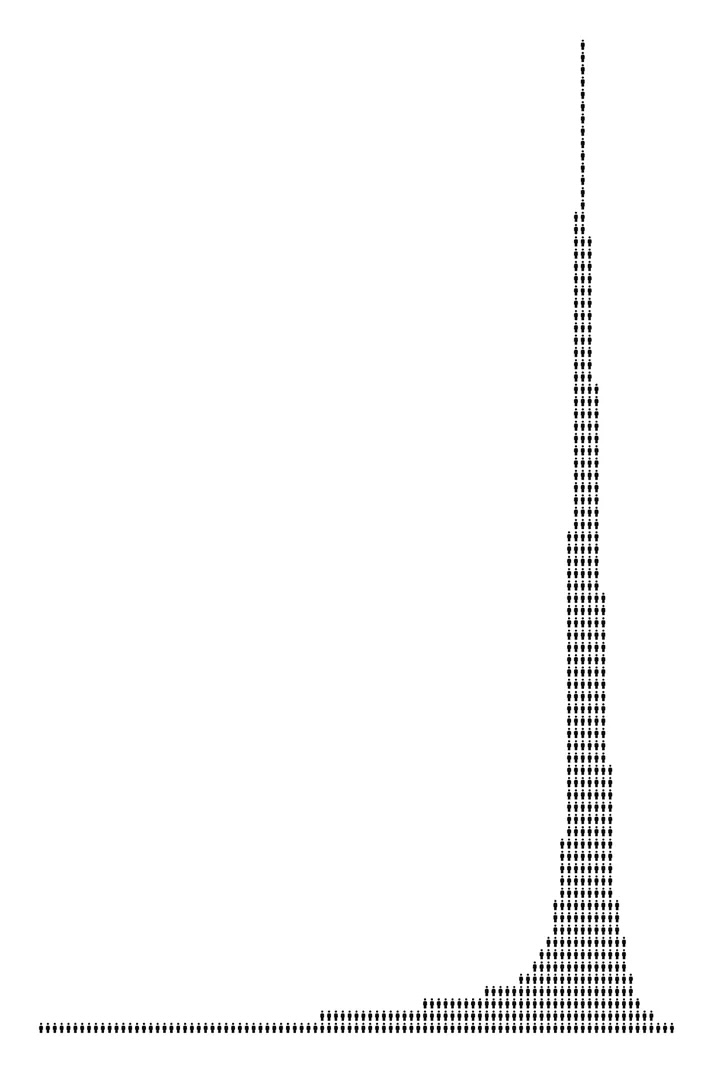
The most striking observation in Dean Spears and Michael Geruso’s new book, After the Spike, is summed up by the cover illustration, which shows a world population rising rapidly to its current eight billion before declining to pre-modern levels and eventually to zero. As the authors observe, this is the inevitable implication of the hypothesis that fertility levels will remain below replacement level indefinitely into the future.

[click to continue…]

… as long as they are healthy, well fed and well educated

Much of the panic about falling birth rates can be dispelled once we realise that (barring catastrophe) there will almost certainly be more people alive in 2100 than there were in 2000. But what about the distant future? Dean Spears, co-author of After the Spike has kindly provided me with projections showing that with likely declines in fertility the world population will decline by half each century after 2100, reaching one billion around 2400. Would that be too few to sustain a modern civilisation ?

We can answer this pretty easily from past experience. In the second half of 20th century, the modern economy consisted of the member countries of the Organization For Economic Co-Operation and Development (OECD). Originally including the countries of Western Europe and North America, and soon extended to include Australia and Japan, the OECD countries were responsible for the great majority of the global industrial economy, including manufacturing, modern services, and technological innovation.

Except for some purchases of raw materials from the “Global South”, produced by a relatively small part of the labour force, the OECD, taken as a whole, was self-sufficient in nearly everything required for a modern economy. So, the population of the OECD in the second half of last century provides an upper bound to the number of humans needed to sustain such an economy. That number did not reach one billion until 1980.

[click to continue…]

The Arguments for More (or Fewer) People

by John Q on July 22, 2025

The New York Times recently published a letter from me responding to a guest essay (op-ed) by Michael Geruso and Dean Spears, with whom I’ve been engaging on the question of pro-natalism. As a colleague who had such a letter published a few years ago observed, this will probably get more readers than any journal article I’ve ever written. The text is over the fold

[click to continue…]

Whatever happened to Romney Republicans?

by John Q on July 8, 2025

Have they changed, or just become their worst selves

While Trump is unpopular with a majority of Americans, his support among Republicans remains solid. That’s despite blatant corruption, fascist policies and a failure to deliver any of the economic benefits he promised. Faced with this depressing fact, the standard New York Times response has been to send an intrepid reporter to “Trump Country” (rural Kentucky or Midwestern diners) to find out what is going on.

But it would be far more instructive to send them to Long Island, where Trump won both counties in 2024. Long Island voters have given solid support to Republicans at all levels. Even as he was crushingly defeated in New York as a whole, Mitt Romney got close to half the vote in Suffolk and Nassau counties. Trump did a few percentage points better in 2024, winning both. But he would have gone nowhere if not for the solid support of Romney voters

This doesn’t fit at all with the usual stories about Trump voters. The residents of Long Island are not the “left-behinds” routinely described in explanations of Trump’s appeal. The average income is over $100 000 and unemployment rates have long been around 3 per cent. Like most New Yorkers, Long Islanders have been beneficiaries of the globalised economy of which Romney was a symbol. And, if you were to believe Jonathan Haidt’s The Righteous Mind they did so because they valued honor, loyalty and purity, qualities Trump routinely trashes.

Democrats from Hillary Clinton on assumed that these contradictions would lead suburban Republicans to abandon Trump in numbers large enough to offset any losses of Democrats attracted by Trump’s racism and misogyny. Evidently this is not the case. Not only have the Republicans who once voted for Romney maintained their support for Trump but they have preferred him to any Republican alternative. And, with few exceptions, they have embraced Trump’s racist and fascist policies, even as he approaches outright Nazism.

What has happened here? Has Trump, as Walter Olson suggests, radicalised his followers leading them to support positions they would once have rejected? Or has he simply allowed them to reveal themselves (or at least their worst selves) as the racists and fascists they always were?

[click to continue…]

The end of US democracy

by John Q on June 29, 2025

I’ve held off posting this in the hope of coming up with some kind of positive response, but I haven’t got one.

When I wrote back in November 2024 that Trump’s dictatorship was a fait accompi there was still plenty of room for people to disagree. But (with the exception of an announced state of emergency) it’s turned out far worse than I thought possible.

Opposition politicians and judges have been arrested for doing their jobs, and many more have been threatened. The limited resistance of the courts has been effectively halted by the Supreme Court’s decision ending nationwide injunctions. University leaders have been forced to comply or quit. The press has been cowed into submission by the threat of litigation or harm to corporate owners. Political assassinations are laughed about and will soon become routine. With the use of troops to suppress peaceful protests, and the open support of Trump and his followers, more deaths are inevitable, quite possibly on a scale not seen since the Civil War.

The idea that this process might be stopped by a free and fair election in 2026 or 2028 is absurdly optimistic. Unless age catches up with him, Trump will appoint himself as President for life, just as Xi and Putin have done.

None of this is, or at least ought to be, news. Yet the political implications are still being discussed in the familiar terms of US party politics: swing voters, the centre ground, mobilisation versus moderation, rehashes of the 2024 election and so on. Having given up hope, I have no interest in these debates. Instead, I want to consider the implications for the idea of democracy.

[click to continue…]

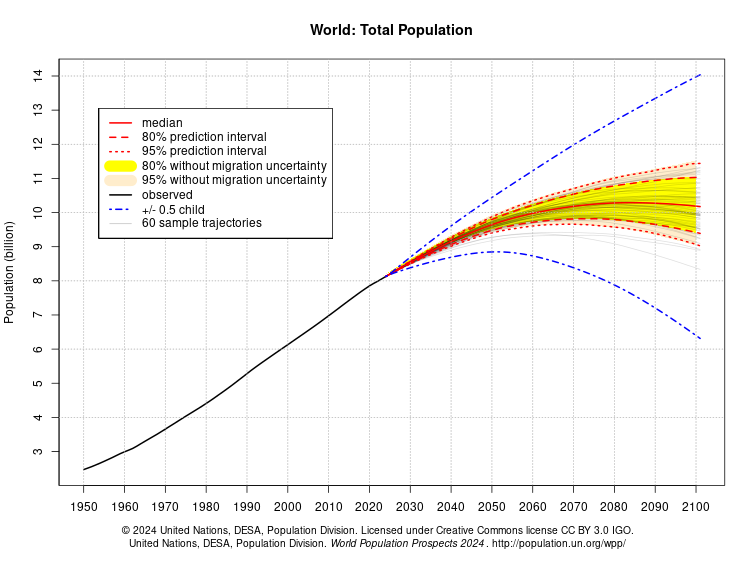
Pro-natalism (the idea that people, or rather, women, should have more babies than they choose to do at present) has become an established orthodoxy,[1]. The central claim is that, unless something changes soon, human populations both global and national, are going to decline rapidly, with a lot of negative consequences. This is simply not true, on any plausible assumptions about fertility[2]

There’s no need for me to do any calculations here. For many decades he Population Division of the UN Department of Economic and Social Affairs has been producing population projections for the world, and individual countries, under a variety of scenarios. One finding is unambiguous. Short of a drastic decline in fertility, far beyond what we are now seeing there will be more people on Earth at the end of this century than there were at the beginning

Graph showing world population projections

[click to continue…]